Sunday, May 8, 2011


Sunday, May 1, 2011
Project #16
For our final project my group decided to create a wiki. We wanted to create a place where teachers who wanted to incorporate tech into their classrooms could find tips on funding their goals. We worked together to start a discussion on where to find grants, how to write them, and also where you could get free technology for your classroom. I had a really great time working with my group all semester and I am glad we were able to keep our same group throughout. By the end of the term we have all learned to communicate well and work as a team to come up with ideas and follow through with them. I feel very lucky to have worked with the people in my group, I learned so much from all of them.

Personal Learning Network - Final Progress Report

I love my PLN. I like building it and thinking of ways to make it stronger. I enjoy adding new tiles to my symbaloo page and finding new people to follow on twitter. I now follow 23 people on twitter. Mostly education related with a few comedians thrown in to lighten the mood in my tweetdeck. Twitter and the suggestions of who to follow have been one of the most important additions to my network that EDM has provided me. It is not only what the people I follow say but what they link to. I could spend hours following the links I find on twitter. I have also added a lot of new programs to my symbaloo PLN since my last progress report. This method of keeping track of things I've learned this semester is something I will certainly continue on with. I love following the blogs of the amazing teachers we have been introduced to this year. I'm very happy with the current state of my PLN and can't wait to watch it grow!
Comments for Teachers April

My first comment was on a post he wrote entitled Opportunity to Learn: EdCamp Omaha. In this post he describes his first unconference. I am definitely inspired to find my way to one of these conferences. The learning and networking possibilities seem endless. I love the free atmosphere that the unconference promotes. This is so much better than the traditional lecture because it encourages conversation and exploration of topics beyond the presenter's knowledge. This is what I wrote to Mr. Goerend about this post:
Hi Russ,The second post that Mr. Goering wrote and I commented on was of a more philosophical nature. He discussed a student who didn't complete a project. His policy states that late work receives zero credit after two days. However, he is faced with a situation where he set a goal to teach through this project because the material was important for students to learn. Now, in sticking by his late policy, he feels he is giving up on teaching this student the objectives he had made for his students. Here is what I wrote to Mr. Goering:
I am also a student in Dr. Strange's EDM310 class. I love that you and your students are using prompts to create daily poetry. It's nice to have a starting point in a project like that. I have heard a lot about these unconferences on twitter and have been wanting to learn more about them. Thanks for sharing your experience with us! This sort of collaborative learning is such a great tool for educators. It's always easier to learn new things if you can talk it through with someone. I'll be visiting your blog again next week and then posting a summary of a couple of your posts on my blog.
Hi Russ,
I am visiting from Dr. Strange's EDM310 class at the University of South Alabama. You brought up such an interesting point in this post. How do we motivate students to turn in projects on time without ending up in a situation where the consequences for late work undo our goals. I think this is similar to the debate that has been going on in our school system in recent months. The school system does not allow students to fail and therefore requires teachers to allow make-ups and retests. What are the lessons we are teaching by not allowing students to learn from the consequences of their actions? Are the lessons they learn from negative consequences more important than the lessons we are testing them on? Thanks for the thought provoking post!
-Megan Simmons
Thursday, April 28, 2011
Blog Post 14 - Special Assignment - Metaphors

In blog post 10 we were asked to discuss a post on John Spencer's blog entitled Don't Let Them Take The Pencils Home. For this week's post we are asked to look more closely at the use of metaphor in John Spencer's blog and the world in general. While reading Spencer's blog for the first time I think there were a few reasons I knew it was a metaphor. First, maybe I'm the only one who's noticed, but, EDM blog post assignments tend to have a common theme. Writing a blog post on integrating technology every week for ten weeks straight leads one to believe that week eleven might have something to do with integrating technology. Second, taken at face value the situation presented in the post is absurd. I refuse to believe that there is a school that discourages the use of pencils in any environment. Third, there were explanations of the metaphor on the page. Located above the body of the post was a link to a post by Larry Ferlazzo where he discusses the study "Mr. Johnson" refers to in his conversation with "Gertrude". The study claims that students with access to computers at home will have lower test scores. You will also notice that, although the blog is written from the point of view of "Tom Johnson" with accompanying old timey photograph, the author is actually named John T. Spencer and you can read his bio. So, there are my reasons for believing this post was a metaphor.
What can I learn from this? In writing this follow up post I have had to examine my own thought processes. Dr. Strange has given those who understood a little food for thought in asking how we know what we know (a little epistemology!). I was very intrigued by this idea. I started with the metaphor and came up with the ideas in the paragraph above. However, I thought I should take this further. I decided to try an experiment and for the last few weeks have been trying be conscious of my grammar. I firmly believe that, in America, speaking standard English as your first language is one of the greatest advantages one can have. I grew up hearing and speaking standard English at home and I don't have to think of specific grammar rules to know if I'm using correct verb tense or sentence structure because I know how standard English should sound. Another part of this experiment is that I am the resident grammar person where I work. At least once a day someone asks me a question about their use of language. For the past few weeks, instead of just telling them the correct word or conjugation I have been going the extra mile and explaining the rule that makes that word or conjugation or pluralization correct. I have found this to be much more challenging. It is a part of my vocabulary that hasn't had much use since eighth grade. Luckily I sit next to my darling sister-in-law and between us we can usually work things out and call them by their right names.
Sunday, April 24, 2011
C4K April
Race For The Cure
I was assigned the "Race for the Cure" section of Mr. McClung's blog to comment on.
Mrs. Yollis
http://yollisclassblog.blogspot.com/2011/04/quality-commenting-during-family.html
Mrs. Yollis's blog is an excellent resource for both students and their parents. By posting what they are studying and how on the blog Mrs. Yollis encourages greater parent participation. This month especially increases the family's connection with the student's education. Family blogging month encouraged comments from family members by providing instructions on exactly what constituted a good comment. Mrs. Yollis and her class expect substantive 3-point comments. Mrs. Yollis's students give guidance on how to produce a quality comment with the following tips:
Jaden
Jaden is in Mrs. Yollis's class and is an excellent writer. The post I commented on for C4K was about a Clippers game he was able to see. I really enjoyed seeing Jaden respond to the comments on his blog. It is clear that he takes his blog seriously and wants to create a genuine conversation with his posts. Here's what I wrote:
I was assigned the "Race for the Cure" section of Mr. McClung's blog to comment on.
Megan Simmons Says:
March 31st, 2011 at 11:58 AM
Hi Mr. McClung!
I am one of Dr. Strange’s EDM310 students. I love how you introduce your students to such a variety of life experiences. These are the things they will always remember! Becoming responsible and caring citizens is such an important lesson to instill in children when they are young. I imagine they will be extremely proud of their contribution and that sense of accomplishment will encourage them to give and share in the future. I’m so glad Dr. Strange has introduced us to your blog so that we can draw inspiration from your classroom.
Mrs. Yollis
http://yollisclassblog.blogspot.com/2011/04/quality-commenting-during-family.html
Mrs. Yollis's blog is an excellent resource for both students and their parents. By posting what they are studying and how on the blog Mrs. Yollis encourages greater parent participation. This month especially increases the family's connection with the student's education. Family blogging month encouraged comments from family members by providing instructions on exactly what constituted a good comment. Mrs. Yollis and her class expect substantive 3-point comments. Mrs. Yollis's students give guidance on how to produce a quality comment with the following tips:
"#1. Make a connection with who you are writing to. That is a great way to interest the person you are writing to!Mrs. Yollis's class blog also provides instruction on how to include a little HTML code in your comments to make them more interesting. This blog was a really fun read I was really impressed by how well spoken her students were in their videos. These kids really know what they're talking about when it comes to blogs. I also learned some great tips on taking photographs!
#2. Try to add some factual information. That makes the person want to add some factual information. That way you can both learn.
#3. Lastly, you should always check your spelling and grammar before you publish your comment. We have learned to go on Microsoft Word and press the grammar and spelling tab under tools.
That makes a great 3-point quality comment.
You can also write a question so your writer wants to comment back."
Jaden
Jaden is in Mrs. Yollis's class and is an excellent writer. The post I commented on for C4K was about a Clippers game he was able to see. I really enjoyed seeing Jaden respond to the comments on his blog. It is clear that he takes his blog seriously and wants to create a genuine conversation with his posts. Here's what I wrote:
Megan Simmons said...
Hi Jaden,
I am in Dr. Strange's class and he assigned your blog for me to read this week. I am really glad he gave me your blog because you always write such great posts. I think you're a really exceptional writer. I specifically like how detailed your stories are. What is your favorite part about having a blog?
I have never been to a Clippers game or any basketball game. It sure does sound like a lot of fun! If I ever visit California I will try and make it to a game.
Thanks for letting us all read your blog and being such a good host. If you have some spare time you are welcome to visit my blog.
From,
Megan
Blog Post #13
Alex
 The Alabama Learning Exchange otherwise known as ALEX is an amazing resource for educators. The first thing you notice about ALEX's home page are the eight large boxes. Each one stating a section of the website and acting as a link. The first box is Courses of Study. As the title suggests this button provides you with links to the ALCOS standards for each subject. Once you click on a particular course of study you are brought to a chart. The chart lists the standards in order of grade level and, in the left column, provides links to both related lesson plans and useful links.
The second button is for weblinks. This button brings you to a menu of link resources for teachers, students and administrators. There is also a button that allows you to suggest a link to the site. Clicking on the teacher web resources button will bring you to a new menu or assorted links organized into several categories.
The Professional Learning button provides you with a list of opportunities from grants to teacher training. One of my favorite sections of ALEX is the Podcast treasury. Podcasts are such an amazing source of information. I can't wait to really delve into what they have in this section.
I found this website to be an excellent resource for teachers. I would certainly be excited to use this to find training opportunities and grants. I think it would also be an excellent resource for students. Students would be excited to be assigned a podcast to listen to once in a while in place of reading a chapter out of their books.
ACCESS
 The purpose of ACCESS is to provide students with a high quality education through distance learning. They achieve this goal by making high school classes available to all students in Alabama. They aim to create a more equal educational opportunity for students unable to attend traditional schools. In reading their mission statement I was impressed by the emphasis on the individual needs of students. Some students who do not succeed in the physical classroom may find that they are better able to focus in an online class. The classes offered are also more varied than those offered at many smaller schools in Alabama allowing students to better explore their talents. The classes implement video conferencing to connect students with their teachers. This is an excellent option for students who want more variety in their education or simply do not strive in the average high school environment.

The second button is for weblinks. This button brings you to a menu of link resources for teachers, students and administrators. There is also a button that allows you to suggest a link to the site. Clicking on the teacher web resources button will bring you to a new menu or assorted links organized into several categories.
The Professional Learning button provides you with a list of opportunities from grants to teacher training. One of my favorite sections of ALEX is the Podcast treasury. Podcasts are such an amazing source of information. I can't wait to really delve into what they have in this section.
I found this website to be an excellent resource for teachers. I would certainly be excited to use this to find training opportunities and grants. I think it would also be an excellent resource for students. Students would be excited to be assigned a podcast to listen to once in a while in place of reading a chapter out of their books.
ACCESS

Sunday, April 17, 2011
Final Project Progress Report
For our final project my group is creating a wiki. The purpose of the wiki is to provide resources to educators who want to incorporate technology into their classroom but feel they don't have the funding or don't know what sort of technology would be most appropriate. Contributors will provide links to websites where you can find grants. The Wiki will also provide tips on writing a grant. We hope this wiki will grow into a community where educators can find guidance on what technology would be most appropriate for achieving their goals and find a way to get the funding necessary to bring that technology to their students.
The wiki will be located at edtechfunding.wikia.com .
The wiki will be located at edtechfunding.wikia.com .
Saturday, April 16, 2011
Blog Post #12
Assignment: Watch the video by Katie Salen about Quest to Learn. In a blog post discuss what Quest to Learn is and whether it you feel it prepares students for the world described by Karl Fisch and Scott McLeod in their video Did you know? which we watched at the beginning of the semester. How can you incorporate some of the methods used at Q2L into your classroom?

Quest to learn is a public school in New York City. The school teaches students through the non-traditional methods of gaming and design. Students are given the opportunity to learn by creating and exploring digital worlds. They are motivated by the same system that motivates them outside of school. The increasing difficulty of tasks they want to complete encourages hard work and collaborative learning. They each develop specialty areas and become teachers as well as students as they work with their peers to create new games.
Are students being prepared for the world described in Did You Know? Yes. On their website Q2L defines the integrated learning practiced at their school by saying
As teachers in schools that don't have all of the amazing resources seen in this video of Q2L we are still able to incorporate the major educational philosophies. We can give our students lessons in which they gather knowledge not just for the sake of knowledge but in order to create something they see as worthwhile and interesting. They don't need to create a 3-D world of Aesop's fables to gain a greater understanding of the stories. They can create a puppet show. If we have access to computers and the internet they can blog about their thoughts on the stories and publish the puppet show they have created in order to gain a wider audience. You can skype with local professors who are experts on the ideas in the fables and give your students the opportunity to ask questions. The main idea is to teach our students how to teach themselves. Information is free for those who know how to take it. What's valuable now is knowing how to use that information and wanting to create and learn and share.

Quest to learn is a public school in New York City. The school teaches students through the non-traditional methods of gaming and design. Students are given the opportunity to learn by creating and exploring digital worlds. They are motivated by the same system that motivates them outside of school. The increasing difficulty of tasks they want to complete encourages hard work and collaborative learning. They each develop specialty areas and become teachers as well as students as they work with their peers to create new games.
Are students being prepared for the world described in Did You Know? Yes. On their website Q2L defines the integrated learning practiced at their school by saying
"At Q2L, students learn by "taking on" the behaviors and practices of the people in real life knowledge domains. Students learn to be biologists and historians, and mathematicians instead of learning about biology, history, or math"These are exactly the skills needed by students in the 21st century. Having facts is no longer a marketable skill. Everyone has facts. Information has been liberated. What is important is learning to gather, synthesize and interpret these facts. That is exactly what students at Q2L are learning to do.
As teachers in schools that don't have all of the amazing resources seen in this video of Q2L we are still able to incorporate the major educational philosophies. We can give our students lessons in which they gather knowledge not just for the sake of knowledge but in order to create something they see as worthwhile and interesting. They don't need to create a 3-D world of Aesop's fables to gain a greater understanding of the stories. They can create a puppet show. If we have access to computers and the internet they can blog about their thoughts on the stories and publish the puppet show they have created in order to gain a wider audience. You can skype with local professors who are experts on the ideas in the fables and give your students the opportunity to ask questions. The main idea is to teach our students how to teach themselves. Information is free for those who know how to take it. What's valuable now is knowing how to use that information and wanting to create and learn and share.
Wednesday, April 13, 2011
Special Assignment

I was so fascinated by Mr. McClung's rules. The main thing I noticed about the rules is that they seemed to create an atmosphere of mutual respect. He respects the students and wants to create an environment in which they are able to share their knowledge. I think someone is doing something right when their class rules make you wish you were in their class!
The syllabus listed the first requirement as a day planner. I would assume this is to teach the students time management and self-direction. He notes that homework loses a letter grade for each day that it is late. Much like the penalty for late work in this class this type of system creates motivation for students to complete work on time.
I visited two links on Mr. McClung's useful links page. The first was convince me, a page that offers students the opportunity to practice their debate skills. I am adding this to my PLN. It explains the rules of debate and allows you to watch or participate in a debate on any topic you like. You can start a debate or join a debate started by someone else. I think this is an excellent way to teach students how to argue and discuss topics without getting upset. This would be a great tool to increase cooperative learning in the classroom. I also visited PDF to Word. While not as exciting as convince me, I was just really excited that this is possible. I always thought you couldn't turn a picture into a word file, or that it was terribly complicated. I can think of a hundred times when I've needed this website for classwork or personal use. This is why I love EDM.
Mr. McClung provides a good list of rules for internet safety. I like that the list is short. Too many rules about what to click and what not to and fifty other things you can't do is discouraging and it makes students likely to forget the most important rules. Mr. McClung gives just a few rules including, don't give out your real name, location, or personal e-mail. I like that he allows the students to use the class e-mail address for communications because it solves the problem of security without denying students access to this important tool. One of the best rules I thought was "Never respond to a threatening email or message." I think it's a very hard lesson for students to learn that responding to internet bullying doesn't solve anything.
The blog is divided into several categories into which Mr. McClung posts. I commented on the section "Race For The Cure". The posts in this section details the class's adventures in building a team and raising money for cancer research.
I was very impressed by the organization of Mr. McClung's blog. I especially liked the tools on the sidebar. The Dropshots application would be a really cool addition to my blog.I also like that he has added a song of the week. The blog allows students, teachers, and parents to know what is going on in the class. I really like the idea that parents can read the lecture notes and see the powerpoint presentations. I think this will go a long way in increasing parent participation.
Sunday, April 10, 2011
Blog Post #11

As a teacher I would absolutely want to have my students writing blogs. Mrs. Cassidy discussed the myriad of benefits to be gained from students publishing their work in a public forum. She noted that blogging gives students an audience. This is so important because it gives them a feeling of importance. I want my students to feel that the work they are doing in class is meaningful. Having people from all over the world view what you have created and give you positive feedback and support your learning lends a meaning to the work that not even an A+ and a scratch-and-sniff sticker can compete with. The students in Mrs. Cassidy's class create blogs using classblogmeister which allows them to know how many people are visiting and where they are visiting from. Knowing that someone in another country is reading their work will surely increase their curiosity about other cultures as well as improve their geography skills.
The students also use wikis. How exciting for them to be able to create and collaborate with the world. I loved that she incorporated culture by having her students ask about the traditions of their audience. Their collaboration with the 2nd grade class in Gadsden was also really exciting because they are learning from and working with students of different ages which helps with their social development.
At one point in the student video the children were asking questions of a geologist who was communicating via skype. I was so excited by this idea. There are so many opportunities to learn from others and using technology makes experts on any subject so much more accessible. Not only are they learning about the subject being taught, but they are also learning to interact with others in a productive way. They are learning to learn by asking questions!
I so hope that I can incorporate these things into my classroom. One obstacle that occurred to me as Mrs. Cassidy was discussing the permission sheet that parents sign to allow students to use the blogs was, what if they won't sign? What if you have one or two parents who are afraid of technology and don't want their kids anywhere near the internet? I would hope to be able to convince them otherwise. If they can't be persuaded do you deny access to all students? Or do you single out those children and give them alternate assignments?
Teach Someone (Project #14)
For this project I have created a tutorial on donating through Kiva. I used Screenr for the video portion but, the sound didn't work so I decided I also needed to create a pdf file with written instructions. However, I didn't know how to create a PDF file so I watched this tutorial which was great because it is based on open office which is a great word processing program that has all the functionality of Word but is completely free. It turns out PDFs are very easy to create. I then learned I did not possess the skills to upload my lovely new PDF directly to blogger. So, I learned how to use dropbox to create public links to specific, large files on my computer. Then it occurred to me that I should learn to upload pdfs directly to blogger. So, I read this blog which didn't help me much except that in the comments someone posted a link to their blog which led me to a great hosting site called scribd and now I know how to do this:How to Donate So. Much. Learning.
Sunday, April 3, 2011
C4T #3 Summary Post
Quantum Progress
For this month's Comments for Teachers assignment I was given the blog of a ninth grade physics teacher in Atlanta, Georgia. The first post I commented on was entitled "Look At Graphs With Your Sixth Grade Mind To See Your Understanding Evolve." This post explained the author's method of encouraging students to self reflect to find the development of their skills. This method seems have several major benefits. First students are able to see the foundation they are meant to be building on which can help them better understand the new lesson they are faced with. Secondly, the students can self assess and get a more clear understanding of their own learning styles. Here is my comment on the post
 The second post I commented on was "Alan Turing and the Day of Silence". In this post the author shares a lecture he gave on Alan Turing. His goal was to show students some of the history of science. He went a step further than just introducing Alan Turing, however and managed to create a moral lesson and a history lesson in one. He first introduced Turing and all of his amazing contributions to history and the modern world. Then he told the students that Alan Turing had been a homosexual and was silenced for admitting this. He gave the lecture on April 15 a Day of Silence when students across the country took vows of silence to take a stand against anti-gay bullying. What a powerful lecture. I was enthralled just reading about it, I can't imagine there was a student in that class who wasn't moved. Here is my comment:
For this month's Comments for Teachers assignment I was given the blog of a ninth grade physics teacher in Atlanta, Georgia. The first post I commented on was entitled "Look At Graphs With Your Sixth Grade Mind To See Your Understanding Evolve." This post explained the author's method of encouraging students to self reflect to find the development of their skills. This method seems have several major benefits. First students are able to see the foundation they are meant to be building on which can help them better understand the new lesson they are faced with. Secondly, the students can self assess and get a more clear understanding of their own learning styles. Here is my comment on the post
March 27, 2011 6:23 pm
Hi, I have been assigned your blog by Dr. Strange as part of edm310 I will be posting my reflections on your posts on my blog.
This is such a creative idea. Self reflection is so important for students. This is a great way for them to look back while having a specific idea to focus on so that their growth is evident. This also might help them recall the basic principles upon which you are building in your lessons.

Hi, I am visiting as part of an assignment for Dr. Strange’s EDM310 class and will be posting my thoughts about your posts on my blog.
I love that you are tying so many other subject areas into your lesson. Integration is such a great way to help students make connections and and see how the information they are learning relates to them personally. It is really inspiring to see a teacher taking the initiative to show students that not all great contributors to our world are old straight white men. It is important to provide role models for all of our students. I can see why you can’t get through the lecture without a lot of hand waving. I was riveted by the story of it alone!
Blog Post 10
An Open Letter To Educators.
 Morgan Bayda is a teacher in Saskatchewan, Canada. In this blog post she discusses her disappointment in the lack of engagement and connection found in a majority of her college classes. She says in her letter
Ms. Bayda included in her post a video by Dan Brown. Dan left college because his education was interfering with his learning. I can see where Dan is coming from in this video. I always have a huge list of books on my reading list by the end of the semester. My kindle is currently gathering dust. Between classes, work, and the time I spend researching random tangents brought up by the posts we read for these blog posts and the links I get from twitter there isn't much time for reading. However, I feel that the way my classes are structured, as mostly project based with plenty of freedom, I can coordinate the things I'm interested in into the projects that require research anyway and in that way my education enhances my learning by guiding and focusing my investigation of topics.
Adventures in Pencil Integration.
 John T. Spencer is a teacher in Phoenix, Arizona. Mr. Spencer's blog is a satirical debate over how much access and what type of access students should have to pencils. In this particular post Spencer is arguing the results of a recent study that suggests that student's from low income families show a decline in test scores when given computer and internet access at home. This is for students given access to these tools after the fifth grade. Students in low income households given access before fifth grade show an increase in test scores. As Mr. Spencer's character Tom Johnson tries to argue in the blog, there are clearly other factors involved. The study suggests that providing low income students with computers and internet access will decrease their learning as evidenced by a decrease in test scores. Why is this? What are students meant to be doing on these school provided computers when they are at home? I would assume homework. I would also assume that most students' main source of homework help is their parents. I would also assume that students from low income households are more likely than their upper income peers to have technologically illiterate parents. Therefore they are less likely to have a support system when they leave the classroom. Therefore, the real solution, as "Tom" argues in the post is not taking computers away from low income students (which may temporarily increase test scores but will certainly decrease genuine learning), but to involve parents and provide them with the training they need to provide their children with support and guidance. I really enjoyed this blog and will certainly be adding it to my PLN if for no other reason than to giggle when he talks about the "pen pal networks" and all the dangers therein.
"I too feel cheated sometimes at University, especially by the time I am finished sitting through two three hour lectures in one afternoon."I can definitely relate to this feeling of wasted time. Taking down notes to later memorize and having no real passion for the material often makes learning seem like a chore instead of an adventure. And if we are not passionate about the subject or the work we are doing then what are we really learning? How much of this information will we carry with us and put to good use? I can definitely agree with Ms. Bayda when she points out that these lecture style classes pale in comparison to her Ed. Computers class. I think she must be taking something very similar to EDM310! When a teacher helps you create your own community and you constantly feel connected to people who share your passion you are much more likely to enjoy learning and seek out more knowledge. However, I don't think it's just EDM. In general the College of Education here seems to have embraced this theory of learning by doing and certainly the theory of connectivism. It's an exception, not a rule, in this department for me to have a class I'm not excited about. I can't remember the last time I was in class and didn't feel engaged or that the information being given wasn't relevant or useful. The idea that future teachers are being educated in this way gives me a lot of hope for the future of K-12 education. If we can remember what it was like to sit through boring lectures and how it feels to be engaged and in control of your learning I think the next generation of teachers can change the current system.
Ms. Bayda included in her post a video by Dan Brown. Dan left college because his education was interfering with his learning. I can see where Dan is coming from in this video. I always have a huge list of books on my reading list by the end of the semester. My kindle is currently gathering dust. Between classes, work, and the time I spend researching random tangents brought up by the posts we read for these blog posts and the links I get from twitter there isn't much time for reading. However, I feel that the way my classes are structured, as mostly project based with plenty of freedom, I can coordinate the things I'm interested in into the projects that require research anyway and in that way my education enhances my learning by guiding and focusing my investigation of topics.
Adventures in Pencil Integration.
Sunday, March 27, 2011
Community Service
I recently participated in the 100-1000 project organized by Restore Coastal Alabama. The project aims to create 100 miles of oyster reef in order to create "create the conditions needed to plant, support and promote more than 1000 acres of coastal marsh and seagrass." I attended two events, one on January 22nd and another on March 19th. I worked with other volunteers to pass bags of oyster shells down a line to the project coordinators forming the actual reefs. Spending a few hours doing this was extremely rewarding. As a teacher I would love to get my students involved in community service. By giving students the opportunity to create something useful for their community or help the people of their community we can improve their self-esteem and their respect for their community. A great place to get ideas for community service projects is National Service Resources. Alternatively students could get involved in charity projects. Such as adopting a needy school and organizing donation drives for the students.
For my skype interview I chose to interview my friend Kristi about Project Esperanza.
For my skype interview I chose to interview my friend Kristi about Project Esperanza.
C4K 4
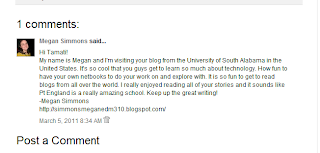
For my March 6th C4K assignment I commented on Tamati's blog. Tamati attends Pt England School in Auckland, New Zealand. The post I commented on was about how excited Tamati was about her first day of class at Tamaki College where she was taking a technology course. This was a very exciting time for Tamati's class because they had just received a set of new netbooks for their classroom. Here is what I wrote to Tamati:
My second C4K assignment was the class blog for Melville Intermediate room 8. The students were given a photography assignment to take 5 pictures for each of the four themes they were given in 15 minutes. The themes were: library, around Melville, odd and students of MIS. The students then used the photos to create a slideshow with music using a program called photopeach. Photopeach allows comments to be posted directly into the video that show up as a credit roll at the end of the video. Here is my comment:


My second C4K assignment was the class blog for Melville Intermediate room 8. The students were given a photography assignment to take 5 pictures for each of the four themes they were given in 15 minutes. The themes were: library, around Melville, odd and students of MIS. The students then used the photos to create a slideshow with music using a program called photopeach. Photopeach allows comments to be posted directly into the video that show up as a credit roll at the end of the video. Here is my comment:

Blog Post #9
What I Learned This Year.
 What I learned this year by Joe McClung is a reflection on his first year of teaching. I am so glad Mr. McClung wrote this post to share his experiences and help new teachers learn from his mistakes before we start our first year of teaching. Hopefully there are some lessons here we don't have to learn through experience.
The first piece of advice Mr. McClung gives is
Another suggestion Mr. McClung makes is to be come a good communicator.
Mr. McClung warns us not to be afraid of technology.
My favorite piece of advice in Mr. McClung's post was to be flexible.
The first piece of advice Mr. McClung gives is
"In order to be effective you have to be able to let your audience drive your instruction."This is a great thing to keep in mind. If we really get to know our students we can form our lessons around their learning styles. By allowing our students to shape our lessons we are ensuring that the focus stays on their learning and not just on our ideas about how lessons should be put together. I think this goes hand in hand with his advice to "be flexible" and "listen to your students."
Another suggestion Mr. McClung makes is to be come a good communicator.
"...communication is one of the hardest skills to develop, so practice all you can and build those strong relationships with teachers and students."This is something I hope I can remember to work hard at. Communicating is important, not only to create a sense of community with your fellow teachers and with your students, but also to attain the goal of continuous learning. You must be a strong communicator to build and maintain a meaningful personal learning network and attain the goal Mr. McClung sets out to "never stop learning". This idea is especially important now as technology is changing so rapidly.
Mr. McClung warns us not to be afraid of technology.
"Technology is our friend and is essential to living in our microwave society of today."Embracing technology alone can help us to achieve the other goals set out by Mr. McClung. It can aid us in learning new methods of teaching to help those students who we are not reaching with our lessons, and it can help us feel connected to our co-workers and educators all over the world.
My favorite piece of advice in Mr. McClung's post was to be flexible.
"When things go wrong, simply work with it and try to better the situation.....and make sure you do it with a smile on your face!"Attitude is everything. Just like Randy Pausch said, we have to make the decision to be an Eeyore or a Tigger. As teachers we have to be able to bring a positive attitude to our classes every day and the only way we can do this is to accept that sometimes things don't go according to plan and sometimes that's okay.
Tuesday, March 22, 2011
Discussions with Sock-rates.
This is a video I produced for EDU301. I created the puppet out of a sock, used buttons for his eyes, and yarn for his beard. I think this would be a great tool for introducing students to lots of historical figures in a fun way.
Subscribe to:
Posts (Atom)